History
IPoDWDM is a networking technology that integrates IP routing directly with optical transport networks.
Before: non-integrated IP + DWDM
IPoDWDM
Functional equivalence of 10GbE + G.709 to 10G POS + transponder, with reduced CAPEX and OPEX.
Why Early IPoDWDM Failed
- IPoDWDM line cards were large and expensive.
- The routers and line cards consumed a lot of energy.
- The line cards had fixed optical interfaces, i.e., not pluggable.
- The IPoDWDM systems were all proprietary to one vendor.
- Regular router port bandwidth grew faster than DWDM capacity.
- Line-side optics were twice the physical size of the client-side, i.e. waste of space.
- IP and Optical teams both wanted control of their domains.
IPoDWDM in 2026
DWDM OEM standard solution
IPoDWDM operator solution
The transponder disappears. The coherent plug sits in the router, and the line system only has to multiplex and route wavelengths.
It’s All About Pluggables
Coherent pluggables make IPoDWDM a reality.
From large, hot and power-hungry…
We have gone from large, hot and power-hungry DWDM plugs and optical engines…
…to MSA “xSFP” form factors with DWDM support.
- IP operators do not like fixed ports or large plugs.
- QSFP-DD and OSFP are very attractive because they solve both these problems.
- Brings 400G easily to routers and switches.
- Can run on dark fibre or integrate with a DWDM system for increased reach.
- High output power of 0dB and +1dB make them a good alternative to embedded.
With the success of 400G, attention turned to 100G and 800G
Source: Smartoptics
- 100G coherent plugs come in the operator-friendly QSFP28 form factor.
- 800G coherent plugs come in both QSFP-DD and OSFP form factors (similar to 400G).
- The hyperscalers are converging on OSFP for 800G-ZR due to its superior thermal management.
- All these fit nicely into routers and switches, offering IPoDWDM capability.
What It Looks Like
400G ZR+ · QSFP-DD / OSFPOpen Optical Line System (OLS)
100s kmOpen Optical Line System (OLS)Switch / Router
QSFP-DD / OSFP
The hyperscaler effect
- Largely driven by the hyperscalers.
- Quick 400G-ZR adoption.
- High volume, low cost.
- 800G-ZR is now next for them.
- * Performance parity with embedded.
And In Real Life
This is a live IPoDWDM network in Cape Town, South Africa – 130km fibre span.
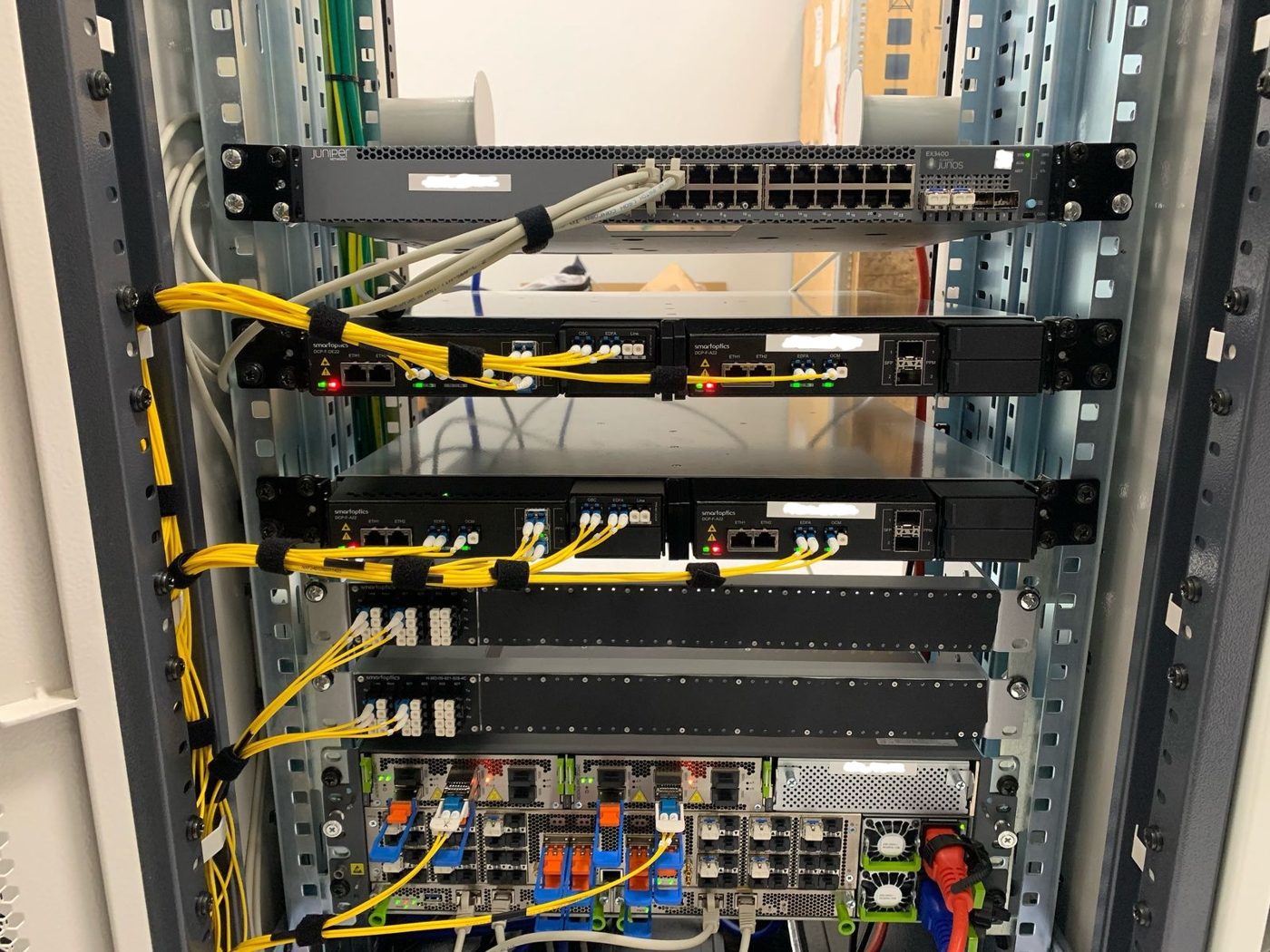
- Juniper Ethernet switch.
- Smartoptics optical line system (East).
- Smartoptics optical line system (West).
- Smartoptics mux/demux (East).
- Smartoptics mux/demux (West).
- Juniper ACX7300 router with 2x Smartoptics 400G-ZR+ QSFP-DD coherent DWDM plugs.
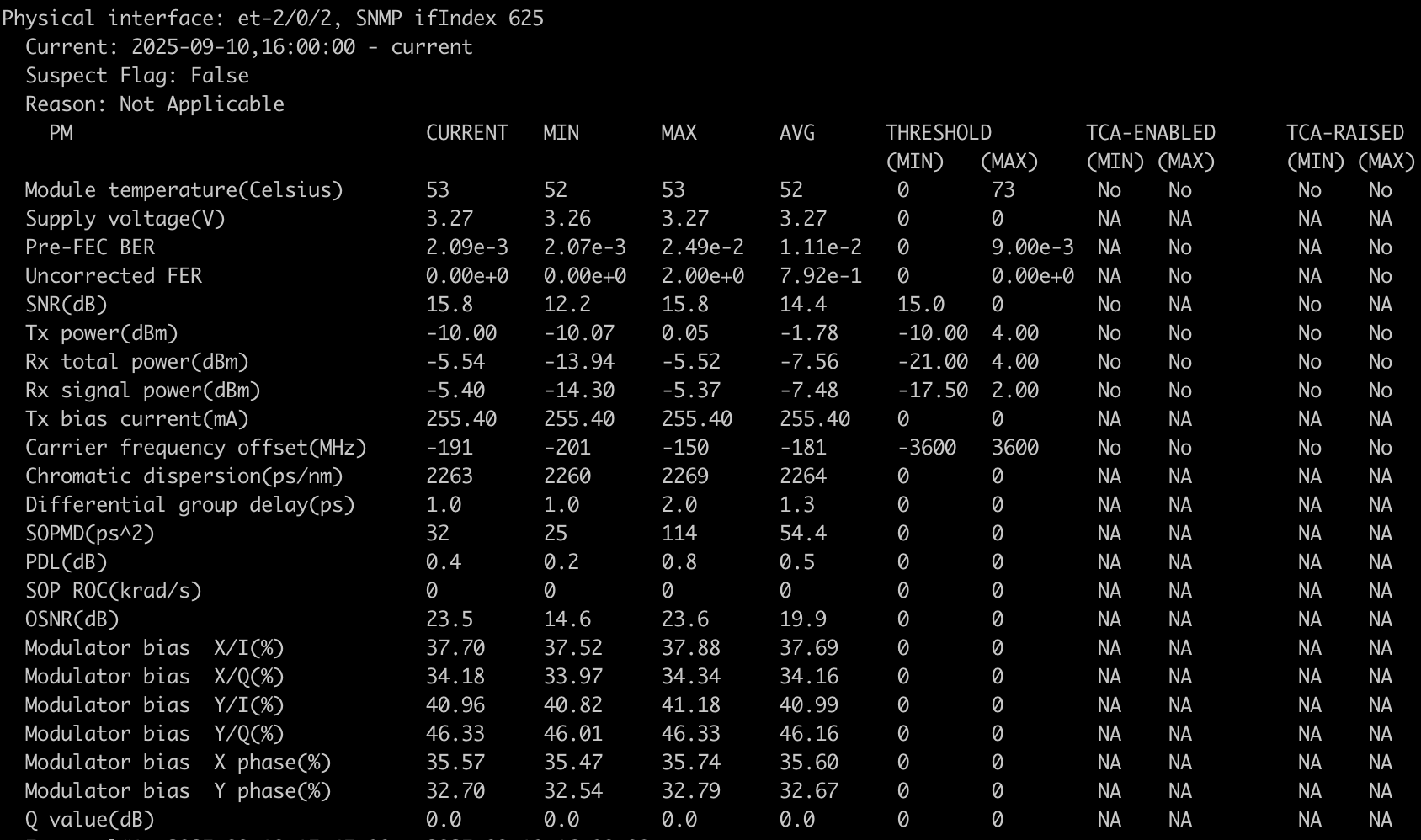
Junos CLI output of the coherent DWDM plugs
Disaggregation
Source: CignalAI
- The hyperscalers had a massive influence on disaggregation.
- Disaggregation = removing the DWDM optic from the host platform.
- In 2025, coherent pluggables outsold proprietary embedded by 2:1.
- Today, most 400G-ZR shipments have gone into hyperscaler IPoDWDM deployments.
- Coherent optics account for more than 60% of all optical revenue.
Pluggable Transponders
Pluggable transponders use plugs for both line- and client-side. Hyperscalers love IPoDWDM. But network operators are “old school” and want transponders. Pluggable transponders bridge the old with the new.
Transponders provide Layer 1:
Pluggables provide:
| Embedded optics | CFP2 pluggable | QSFP-DD pluggable | QSFP-DD / OSFP pluggable |
|---|---|---|---|
| 400G / 800G / 1.2T | 400G | 400G | 800G |
| Gen60P / 90P / 120P | Gen60C | Gen60C | Gen120C |
Source: Smartoptics
Benefits of IPoDWDM
| Before | With IPoDWDM |
|---|---|
| Low system capacity DWDM vs. client ports | Maximum system capacity for both DWDM and client ports |
| Dedicated line cards line- and client-side | Mix-and-match on same card line- and client-side |
| Proprietary DWDM ports no inter-op with other OEM’s | 100/400/800G-ZR standards inter-op with other OEM’s |
| Restrictive alien wave support proprietary OEM systems | Open line systems standardized management API’s |
| Scarce router capacity IP traffic outpaces DWDM | Sufficient router capacity Moore’s Law silicon advancement |
Opportunities for Peering Architectures
400G peering + IPoDWDM backhaul to the nearest PoP.
IPoDWDM makes peering scalable.
Challenges of IPoDWDM
Host inter-op is the biggest question.
- C-CMIS (Coherent Common Management Interface Specification). Defined by OIF.
- C-CMIS standardizes how coherent pluggables and hosts communicate for management and control.
- The goal: any plug in any host.
- Router/switch OS requires C-CMIS support. Not always easy unless you are a big customer.
Two teams, one network

In this network, IP and Optical teams each want control of the network. The solution is two-fold:
- Top-down management of routing, especially in large networks.
- Sharing of modem telemetry data between both the IP and Optical teams.
The Management Question
Different API standards solve different problems
- CMIS looks at host & pluggable.
- OpenConfig looks at common data models.
- NETCONF and gNMI handle data retrieval and configuration.
- SNMP is still widely deployed as a standard management tool.
- REST and Kafka feed data northbound into the OSS.
Could removal of the transponder layer reduce the amount of data the OSS has to present?
IPoDWDM may not lead to a single management plane. But it removes one of the major reasons several management planes existed, in the first place. The optical controller has a legitimate role, but the transponder management plane can disappear.
Traditional layered architecture
IPoDWDM: fewer managed layers
The optical domain remains — but the dedicated transponder layer can disappear.
Deterministic service mapping
- IPoDWDM can reduce the number of independent control and management planes.
- Long term, the direction would be common orchestration and shared telemetry, rather than multiple isolated islands.
Does IPoDWDM Make Sense for Me?
Grey
- You don’t own an optical network.
- You operate a small metro network.
- You require long-haul services.
- You have slow capacity upgrade cycles.
- You don’t need more than 100G-sized links.
- You provide only IP-based services.
- You want to limit costs to IP infrastructure only.
- You don’t intend to grow too quickly.
Coloured IPoDWDM
- You operate your own optical network.
- You operate a large metro network.
- You require short- and long-haul services.
- You upgrade capacity very regularly.
- You need links in excess of 100G capacity.
- You want to free up costly transponder ports.
- You want a low-cost entry into DWDM.
- You want to aggressively drop per-bit costs.
Future – The Linear Way
Hyperscalers will invest heavily in 800G-ZR IPoDWDM from 2026.
Network operators will go a bit slow, focusing mainly on 400G-ZR and pluggable transponders.
Adoption driven more by operating model (forward-looking vs. legacy), than anything else.
Traditional DWDM vendors will see a decline in embedded optical engine sales.
Traditional DWDM vendors will try to balance legacy technology with pluggables.
Embedded optical engines will remain for challenging applications, e.g., subsea and ultra long haul.
Pluggables will be 2 – 3 years behind embedded optical engines. But convergence is speeding up.
Attention has now turned to 1600-ZR (1.6T) coherent pluggables.
Future – The “BYOTx” Way
Wholesale optical service models
Provider owns terminal optics
Shared optical responsibility
Customer owns optical layer
Coherent pluggables expand the practical space for alien wavelengths, spectrum services and BYO terminal equipment.
- We are used to buying either dark fibre or capacity.
- Spectrum services sit somewhere in the middle.
- If I can present a qualified coherent pluggable or optical terminal, a carrier could sell me a defined piece of spectrum and an optical performance envelope, in lieu of a transponder-based Ethernet hand-off.
- It’s a “Bring Your Own Transceiver/Terminal” model, where the customer controls the modem, and the carrier controls and assures the photonic path.
Final Thoughts
- 01IP/MPLS engineers are going to come across IPoDWDM as their networks grow.
- 02IP/MPLS engineers will need to have a basic understanding of DWDM and coherent technologies.
- 03IP & Optical domains will require top-down management intervention to collaborate.
- 04Network operators are going to democratize their vendor pool list for optical equipment.
- 05Traditional optical vendors are going to have to adapt to the changing landscape.
- 06The likelihood of encountering IPoDWDM increases as you get to and exceed 100G.